Facebook
 X
X
 Pinterest
 Copy Link
Short answer: budget 45 to 60 days from listing to closing. Montgomery County homes that sold in August 2026 were on the market a median of 15 days before going under contract, and a financed settlement typically adds another 30 to 45 days.
But there’s a second number you need, and almost nobody publishes it next to the first one. That 15-day figure only counts homes that sold. The listings sitting on the market in Montgomery County right now have a median age of about 43 days. Half of the active inventory has been available for longer than six weeks.
Both numbers are true. The gap between them is the whole story, and it’s the difference between a sale that wraps up in about seven weeks and one that drags on for months.
Last updated: September 28, 2026.
A disclosure before I go further: I’m a listing broker, and I get paid when homes sell. Read what follows knowing that, and check the underlying data yourself — I’ve sourced all of it at the bottom.
Quick facts: Silver Spring and Montgomery County timelines right now
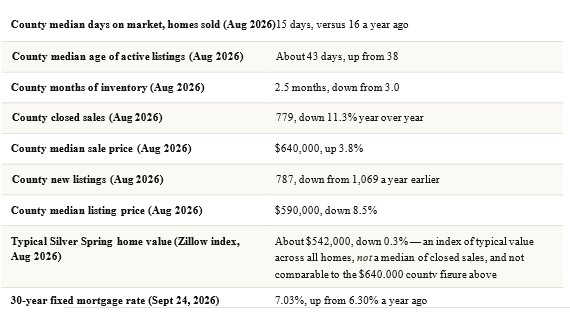
Two notes on that table.
First, inventory. Realtor.com’s active listing count for Montgomery County is up 21.7% year over year, to 2,073. Bright MLS, via Maryland REALTORS, reports active inventory down over the same period, from 2,375 to 2,032. Those are the same nominal metric moving in opposite directions, and the gap comes from what each source counts — the two feeds treat coming-soon, pending and temporarily-off-market listings differently. I don’t think either is wrong; I do think it means nobody should hang a pricing decision on a single inventory
number. What both agree on: the listings that are sitting are sitting longer.
Second, you will see much higher day counts on Redfin and Realtor.com than the 15-day figure above. Those are averages, use different definitions, and are not the same measure as the Bright MLS median. Averages on days-on-market run far higher because a handful of very long-sitting listings pull them up.
Third, on the 15-day figure itself: that’s the Bright MLS median for closed county sales, and it is roughly flat
year over year. Some local brokerage commentary this August described homes as taking longer, which is what you’d expect if you were reading the active-inventory age rather than the closed-sale median, or a subset of the county. If the difference matters to your decision, ask me to pull the current Bright MLS report for your specific submarket rather than relying on any single county-wide number.
Silver Spring is also not a city. It’s an unincorporated part of Montgomery County, so there is no Silver Spring line in the official monthly statistics. Every county figure above includes Bethesda and Potomac, which run considerably higher.
How long does it take to sell a home in Silver Spring right now?
Break it into three stages, because “how long does it take” means different things to a seller getting ready to list, a seller under contract, and a seller trying to plan a move.
Prep, typically one to three weeks. Photography, repairs, decluttering, paint, and getting the house genuinely ready. This is the stage sellers skip and then pay for later in extra market days.
Market time, a median of 15 days for homes that sold. That’s the Montgomery County Bright MLS figure for August 2026. In practice it clusters. Well-prepared homes at defensible prices can go under contract in the first weekend, anywhere in Silver Spring. Homes that are dated, awkwardly laid out, or priced on hope can sit for months — also anywhere in Silver Spring. The variable is the house and the price, not the neighborhood.
Settlement, 30 to 45 days for a financed buyer. Appraisal, underwriting, title work, and the walkthrough. A cash buyer can close in as little as a week or two; a conventional loan with an appraisal issue or a repair
negotiation can stretch past 45 days.
Add those up and a realistic plan is 45 to 60 days from the day you list, and roughly two months from the day you decide to sell. If your house needs work first, extend the front end accordingly.
Why do the 15-day and 43-day numbers both exist?
This is the single most useful thing to understand about market timing, in Silver Spring or anywhere.
Median days on market is measured on closed sales. It’s a survivor statistic. It answers “of the homes that found a buyer, how fast did that happen?” By construction, it excludes every listing that is still sitting there unsold — which is exactly the population you most want to avoid joining.
The median age of active inventory is the opposite view. It answers “of what’s for sale right now, how long has it been for sale?” In Montgomery County that number is about 43 days and rising.
Read together: this is not a slow market. It’s a bifurcated one. There is a fast lane and a stalled lane, and which lane your listing lands in is decided largely in the first ten days by three things — price, condition, and
photography. Those first ten days are when your listing gets the largest audience it will ever have, because that’s when it surfaces as new inventory in every buyer’s saved search. In my experience, a house that misses that window tends to take both longer and less, because buyers read a listing that’s been sitting as a listing with a problem.
How long does settlement take after I go under contract?
Assume 30 to 45 days for a financed buyer. The sequence, roughly:
The inspection happens in the first week to ten days, and any repair negotiation follows. The lender orders the appraisal, which in Montgomery County usually comes back within two to three weeks of contract. Title work runs in parallel — the settlement company pulls the deed history, checks for liens, and resolves anything
outstanding. Underwriting clears in the final two weeks, and a walkthrough happens in the last day or two.
Things that reliably extend it: a low appraisal that requires renegotiation, a title problem such as an old lien or an estate issue, a buyer changing loan products mid-stream, and condo or co-op document delivery. Things that shorten it: cash, a pre-inspected house, and a settlement company that’s already pulled title before ratification.
What slows a Silver Spring sale down?
Some of the most common delays here are specific to the housing stock and to Montgomery County’s rules.
The age of the housing. A large share of Silver Spring’s housing stock dates to the 1940s through the 1960s, though this varies sharply by area — the inner neighborhoods near downtown skew much older than the postwar and later subdivisions farther out toward Aspen Hill and Olney. Where the house is mid-century, that era brings recurring items that turn into lender conditions or repair requests: buried heating oil tanks,
galvanized supply lines, 60- or 100-amp electrical service, asbestos in siding or floor tile, lead paint in pre-1978 homes, and basement moisture. None of these is fatal. All of them are faster and cheaper to address before you list than after an inspection report puts them in a buyer’s hands.
Tenants, if the house is a rental. Two different rules can apply, and they sit at different points in your timeline.
For smaller rentals, Maryland’s right-of-first-refusal statute requires the owner to give the tenant written notice
before offering the property for sale, after which the tenant has a window — 30 days under the statute — to deliver a written offer to purchase. That step happens before you list.
For larger buildings, Montgomery County’s right-of-first-refusal law works the other way around: you list and market normally, and once you have a ratified contract the County requires that the same terms be offered to Montgomery County, the Housing Opportunities Commission, and any certified tenant organization, on a short deadline after ratification. Those windows — commonly 60 days for the County or HOC and up to 90 for a certified tenant organization — sit between ratification and closing, not before listing, so they extend your settlement rather than your market time.
Unit-count thresholds, notice forms and deadlines are technical, and the state and county rules can overlap at the margin. If you own a Silver Spring rental of any size, have a Maryland attorney map the sequence for your specific property before you do anything — a missed statutory deadline can unwind a sale.
Deferred maintenance you decided to let the buyer handle. In a market where buyers are financing at 7%, they have no cash cushion for surprises, and they discount unknown conditions more heavily than the repair would have cost you.
Pricing above the comps. The 43-day active-inventory median is made almost entirely of this.
What makes a Silver Spring home sell faster?
Price set from closed comps within a half-mile, not from what your neighbor is asking. Listed prices are opinions; closed prices are what appraisers and buyers actually work from.
Condition and presentation done before the first photo. Paint, floors, decluttering, landscaping, lighting, and a deep clean. These are the highest-return dollars in a bifurcated market because they decide which lane you land in.
Professional photography and a real marketing plan. Nearly every buyer sees your house on a screen before they see it in person, and in Silver Spring’s older housing stock, photography is doing a lot of work.
A pre-inspection. Knowing your own issues lets you fix, disclose, or price them on your terms instead of reacting to a buyer’s report on day nine. A pre-inspection is not a substitute for Maryland’s required property disclosure or disclaimer, and anything you learn from it may become disclosable — another reason to talk it through before you order one.
Proximity and transit access, which you can’t change but should market. The Red Line stops at Silver Spring, Forest Glen, Wheaton and Glenmont; the FDA’s White Oak campus is a major nearby employer; and the Purple Line is under construction with officials targeting late 2027, though that date has already moved and nobody can promise what any given line does to a specific house’s value.
Does the time of year change how fast my Silver Spring home sells?
Spring, roughly March through May, is the heaviest buyer-traffic window in most Mid-Atlantic markets, and market times are generally shortest then.
The countervailing point for fall 2026 is supply. Montgomery County new listings in August were 787 against 1,069 a year earlier — a drop of about 26%. Fewer competing sellers right now is a real advantage, and every seller who waits for spring becomes part of the spring wave. Whether the extra traffic later outweighs the lower competition now depends on your own timeline, your equity, and how ready your house is today.
Frequently asked questions
How long does it take to sell a house in Silver Spring, Maryland?
Plan on 45 to 60 days from listing to closing. Montgomery County homes that sold in August 2026 spent a median of 15 days on the market, and a financed settlement typically adds 30 to 45 days. Homes that need work, or that are priced above the comps, can take considerably longer.
Why is the median days on market only 15 days when houses seem to sit for months?
Because median days on market counts only homes that sold. The listings currently active in Montgomery
County have a median age of about 43 days. The market is split between homes that go under contract quickly and homes that stall, and pricing and condition largely decide which group a listing joins.
How long does settlement take in Montgomery County?
Usually 30 to 45 days for a buyer using financing, covering inspection, appraisal, title work and underwriting.
A cash buyer can close in a week or two. Low appraisals, title issues and repair renegotiations are the most common causes of delay.
Is the Silver Spring market slowing down in 2026?
Sales volume is down — Montgomery County closed 779 sales in August 2026, an 11.3% drop — while the median sale price rose 3.8% to $640,000 and market time held roughly flat at 15 days. Active listing counts are up and asking prices have softened. It’s a slower, more price-sensitive market, not a collapsing one.
Do I have to notify my tenant before selling my Silver Spring rental?
Often yes, and the timing depends on the size of the property. For smaller rentals, Maryland’s right-of-first-refusal statute requires written notice to the tenant before the property is offered for sale, with a window for the tenant to deliver a written offer — a step that comes before you list. For larger buildings, Montgomery County requires that a ratified contract’s terms be offered to the County, the Housing Opportunities Commission, and any certified tenant organization shortly after ratification, so those windows fall between contract and closing.
Unit thresholds and deadlines are technical; have a Maryland attorney map the sequence for your property before you list.
What’s the fastest way to sell a house in Silver Spring?
A cash buyer is fastest, often one to two weeks, but typically at a discount to market. For most sellers the faster
and better-netting route is a correctly priced, pre-inspected, well-photographed listing, which in this market tends to go under contract inside the first two weeks.

SOURCES
- Maryland REALTORS, August 2026 housing statistics (Bright MLS data), Montgomery County and statewide
- com active-listing and median-listing-price data via FRED, Montgomery County, August 2026
- Zillow Home Value Index, Silver Spring, MD, August 2026
- Freddie Mac Primary Mortgage Market Survey, 24, 2026
- Maryland Code, Real Property 8-119 (tenant right of first refusal)
- Montgomery County Code 53A-4 and DHCA right-of-first-refusal guidance
- S. Census Bureau, American Community Survey 2020–2024, housing age by year built
This article is for general information and is not legal, tax or financial advice. Timelines vary by property, buyer financing, and title condition. Market data changes; figures reflect the most recent available as of September 28, 2026. Confirm any tenant-notice or right-of-first-refusal requirement with a Maryland-licensed attorney.